
Hannah Fowles felt herself unraveling.
After a grueling day at work, the 22-year-old from Provo, Utah, returned home with panic rising in her chest. Her thoughts raced, her cheeks flushed, and she struggled to regain control.
“I was getting really overheated and couldn’t calm down,” Fowles told The Post. “None of my usual go-to methods—like breathing exercises or lying in a dark room—were helping.”
Then she noticed the bag.

Hannah Fowles now carries an “anxiety bag” with her to manage stress, overstimulation and other challenges wherever she goes.
Just weeks earlier, she and her therapist had assembled a small, grab-and-go kit filled with items designed to calm her mind when anxiety hits — an idea she first discovered while scrolling on TikTok.
That night, she reached for it. She took her anxiety medication, pressed a cold pack to the back of her neck and switched on a small portable fan, letting the cool air wash over her face. In her other hand, she squeezed a spiky fidget toy, its prongs digging into her palm as the panic slowly subsided.
“Within 10 minutes, I was able to calm down and go to sleep. It normally doesn’t happen that quickly,” Fowles said. “I never would have thought to have these things until I made the bag. It’s been a game-changer — I use it all the time.”
She’s far from alone.
Packing for panic
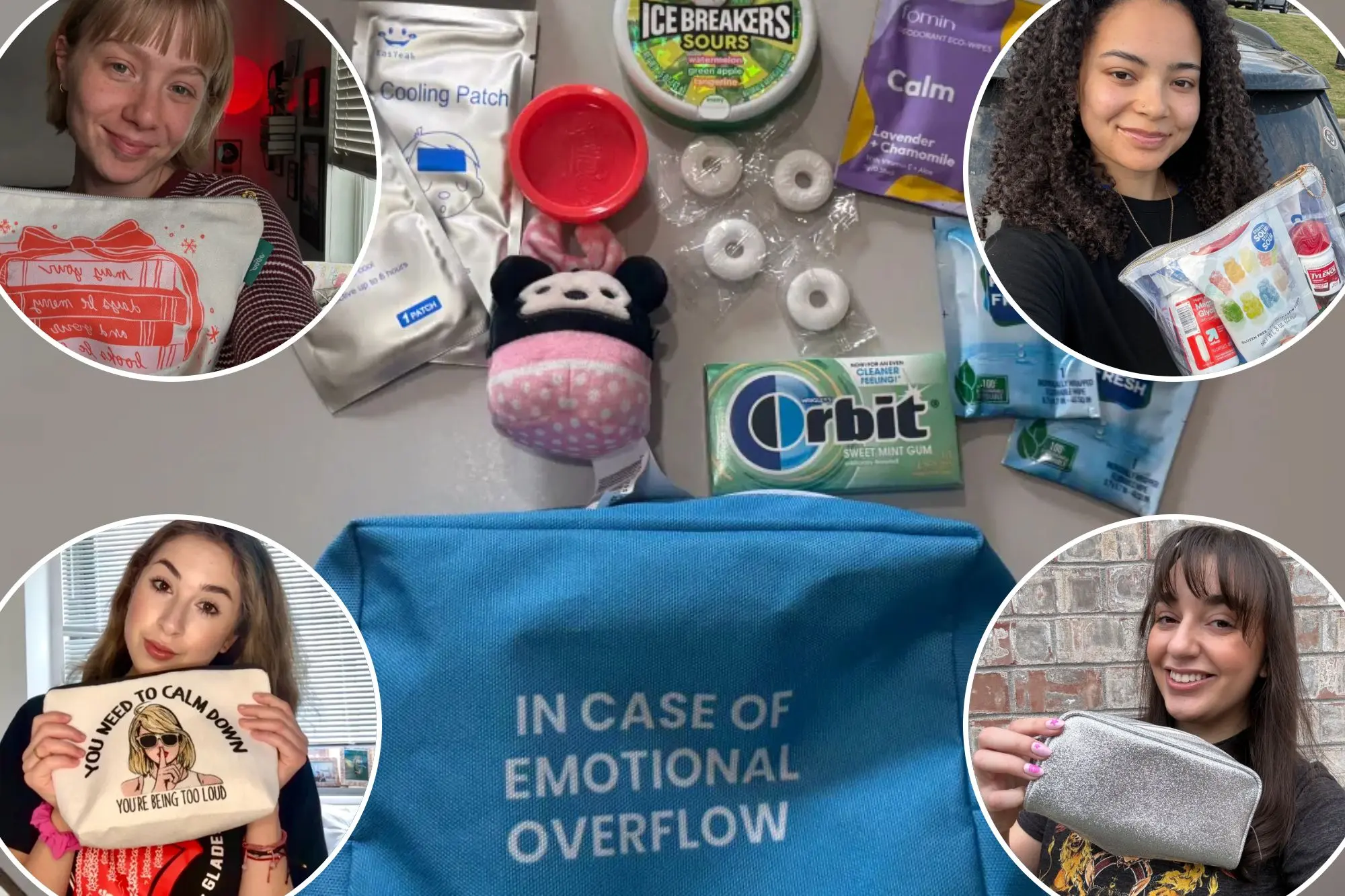
Call them anxiety bags, panic pouches or calm-down kits — whatever the name, these DIY creations are quickly gaining traction online, especially among Gen Z women.
It’s not hard to understand why. In a survey of nearly 1,000 Americans ages 18 to 26, 61% reported having a diagnosed anxiety condition, while 43% said they experience a panic attack at least once a month.
And while many rely on talk therapy and medication to cope, those strategies don’t always help in the heat of the moment.
“Practices like mindfulness and body scans are effective, but you have to remember to use them,” said Dr. Kyra Bobinet, a physician and behavioral neuroscientist. “In highly stimulating environments, when you’re overwhelmed, it’s not always possible to access those tools right away.”


Stefany Staples says her anxiety bag has been especially helpful in easing stress while she’s on the road — a common trigger for her.
Inside the small pouch, she keeps a few go-to items, including lavender essential oil to calm her nerves and sour candy, whose sharp flavor helps snap her attention away from spiraling thoughts.
“It helps me ground myself,” Staples said. “It definitely pulls me out of the anxious cycle happening in my head.”
“An anxiety bag is like your very own superhero toolbox. It’s all about using your five senses to bring you back to the present.”
Carrie Berk, 23
Rapid sensory interventions — like holding an ice pack, sucking on a sour candy or even smelling an alcohol wipe — can help interrupt rising anxiety by jolting the nervous system, explained Dr. Jenny Martin, a clinical psychologist and founder of Gemstone Wellness in Chicago.
“In general, anxiety bag items work by shifting attention away from those anticipatory thought loops and back into the present — back into the body,” Martin said, noting she’s created similar kits with her own patients. “These tools don’t address the root of anxiety, but they can be very effective in acute moments, especially when paired with strategies like cognitive reframing or exposure work.”
Tailoring the toolkit — what works for you?
Not every strategy works the same for everyone.
“Understanding what’s driving your anxiety is key to figuring out what will help calm your ‘worry center,’” said Dr. MaryEllen Eller, a board-certified psychiatrist and Southeast regional medical director at Radial.
For people triggered by sensory overload, she recommends tools that reduce input — like noise-canceling headphones paired with calming music.
If anxiety stems more from racing “what if” thoughts, grounding techniques may be more effective.
“This could include a strong sensory experience, like chewing mint gum or ginger candy while focusing on the taste, smell and texture,” Eller said. “Fidget tools or textured objects can also provide a powerful sense of touch to anchor you.”
Her advice: experiment with different techniques in a calm setting to discover what works best — and once you do, practice using them regularly so they’re easier to rely on when anxiety strikes.